How long does it take to form a habit?
The best evidence we have says around two months for a simple daily habit, and often longer. The number most people quote, 21 days, doesn’t come from habit research at all.
In the research sense, a habit is something you do automatically when a familiar cue shows up. You pour your morning coffee and reach for your vitamins without deciding to. Researchers measure how automatic a behavior feels, then track how that changes as people repeat it every day.
- Median: 66 days to reach a plateau of automaticity (Lally et al., 2010).
- Range: 18 to 254 days, depending on the person and the habit.
- Across studies: medians of 59 to 66 days, in a 2024 systematic review of habit formation research (Singh et al., 2024), with means of 106 to 154 days.
So if you’re on day 30 and it still takes effort, nothing is wrong with you. You’re right in the middle of the curve.
What did the 66-day study actually find?
The study behind the number is Lally, van Jaarsveld, Potts and Wardle (2010), published in the European Journal of Social Psychology. Ninety-six volunteers each chose one new eating, drinking or exercise behavior to do once a day, tied to a daily cue such as “after breakfast”. For 12 weeks they logged whether they did it and rated how automatic it felt.
Automaticity rose quickly at first, then levelled off, like a curve flattening out. The researchers modelled the point at which each person reached 95% of their own plateau.
| What was measured | What they found |
|---|---|
| Median time to automaticity | 66 days |
| Range between people | 18 to 254 days |
| By type of habit | Simple eating and drinking habits, like a glass of water with lunch, tended to plateau sooner than exercise habits |
| Missing a day | Missing one opportunity did not materially affect the process |
| Shape of progress | Fast gains early on, then a slow levelling off |
| Who took part | 96 volunteers, each with one daily habit, for 12 weeks |
Two honest caveats. The study ran for 84 days, so the longest estimates are projections from each person’s curve rather than observed endpoints. And the group was small and self-selected. Still, the picture has held up: a 2024 systematic review by Singh and colleagues looked at 20 studies of health habits. The ones that measured timing found medians of 59 to 66 days, with individual times anywhere from 4 to 335 days.
Where does the 21-day idea come from?
From a plastic surgeon, not a habit study. In his 1960 book Psycho-Cybernetics, Maxwell Maltz wrote that his patients seemed to need a minimum of about three weeks to get used to a change: a new face after surgery, the loss of a limb, a new home. He was describing how long it takes to adjust to something, and he called it a minimum.
Over the decades, “a minimum of about 21 days to adjust” turned into “it takes 21 days to form a habit”. It’s a tidy number and easy to sell. The trouble is that people who expect to be done by day 21 often decide they’ve failed on day 22, when the habit still takes effort. It hasn’t failed. It just isn’t finished yet.
Does missing a day ruin a habit?
No. In the Lally study, missing one opportunity to do the behavior did not materially affect habit formation. Automaticity kept building when people picked up again the next day.
What does hurt is what often happens after a miss: the all-or-nothing thought that the streak is gone, so why bother. Many habit trackers make that worse by resetting a streak to zero. We think that’s the wrong lesson from the research. One missed day is noise. A long gap is what lets the cue and the behavior drift apart, so the useful move is simply to do the next day.
How long does it take to break a habit?
Honestly, nobody has a reliable number. Breaking habits has been studied much less than forming them, and it’s a different problem: the old cue still fires, and the old response is already automatic. What the research on habits does suggest:
- Change the cue where you can. Habits are tied to context, which is why they are often easier to change when life changes anyway: a move, a new job, a new routine.
- Replace rather than resist. Plan a specific alternative for the same cue: “when I get into bed, I read two pages instead of opening my phone.”
- Add a little friction. Make the old habit slightly harder (charge the phone in another room) and the new one slightly easier (leave the book on the pillow).
- Expect a similar timescale. If a new habit takes around two months to become automatic, a replacement habit probably needs about as long to win out.
How can you make the 66 days easier?
Everything that helps is about making the daily repetition easy and consistent, because repetition in the same context is what builds automaticity.
- Start smaller than you think. Two pages beats a chapter. A habit small enough to do on a bad day gets repeated, and repetition is the whole game.
- Attach it to something you already do. Every participant in the Lally study used a cue like “after breakfast”. Habit stacking is the same idea: “after I pour my coffee, I take my vitamins.”
- Keep the same time and place. A consistent context is what turns repetition into a habit.
- Keep a visible record. Seeing the days add up is quietly motivating. An app works, and so does a sheet of paper: try our free printable 66-day tracker.
- Decide your bad-day version in advance. One push-up, one line in a journal, one glass of water. It keeps the cue and the behavior connected when life gets busy.
- Track one to three habits at first. Add more once the first ones feel automatic. If you need ideas, here are 80+ habits to track.
How does Mosaik’s 66-day canvas work?
Mosaik is a calm habit tracker for iPhone built around the 66-day number. You choose a picture. Each full day of habits adds one piece of sea glass to it, and the image stays hidden until day 66.
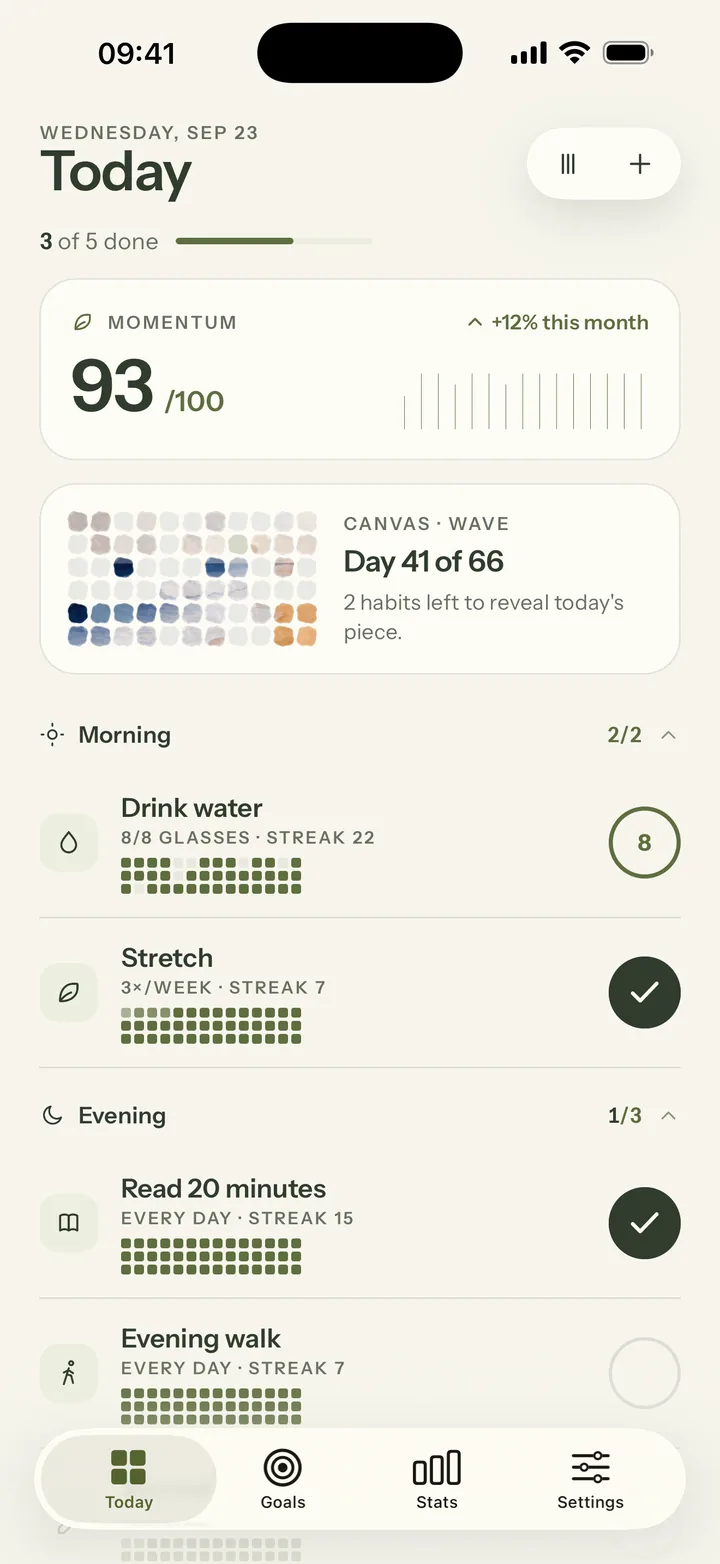
Around the canvas, Mosaik has the things that make the middle stretch easier: reminders with habit-stacking nudges, easy days for heavy days, breaks for holidays, a journal for a line and a mood, and a full-year history grid. It’s free for up to 3 habits. Mosaik Plus adds unlimited habits, Apple Health auto-tracking and a weekly AI coach.
Sources
- Lally, P., van Jaarsveld, C. H. M., Potts, H. W. W., & Wardle, J. (2010). How are habits formed: Modelling habit formation in the real world. European Journal of Social Psychology, 40(6), 998–1009. doi:10.1002/ejsp.674
- Singh, B., Murphy, A., Maher, C., & Smith, A. E. (2024). Time to form a habit: A systematic review and meta-analysis of health behaviour habit formation and its determinants. Healthcare, 12(23), 2488. PMC11641623
- Maltz, M. (1960). Psycho-Cybernetics. Prentice-Hall.
Frequently asked questions
Does it take 21 days or 66 days to form a habit?
66 days is the better guide. The 21-day figure comes from Maxwell Maltz’s 1960 book Psycho-Cybernetics, which was about adjusting to change, not about habits. In a 2010 study by Lally and colleagues, new daily habits took a median of 66 days to become automatic.
How many days does it take to form a habit?
For a simple daily habit, most people need around two months, and some need much longer. The median in the best-known study was 66 days, and individual times ranged from 18 to 254 days. A 2024 systematic review found medians of 59 to 66 days.
Does missing one day reset a habit?
No. Lally et al. (2010) found that missing a single opportunity did not materially affect the habit formation process. What matters is picking it up again the next day, not a perfect streak.
How long does it take to break a bad habit?
There is no reliable number, because breaking habits has been studied far less than forming them. It tends to work best when you change the cue and replace the old behavior with a new one, and that replacement probably needs a couple of months to become automatic too.
Why do some habits take longer to form than others?
Effort and complexity. In the 2010 study, simple eating and drinking habits tended to become automatic sooner than exercise habits. A consistent cue, the same time and place each day, and a small starting size all help.
Is 66 days the same for everyone?
No. 66 days is a median, so half the people in the study took less time and half took more. Treat it as a realistic guide rather than a deadline: if a habit still takes effort on day 40, nothing has gone wrong.