What is habit stacking?
Habit stacking is a way to start a new habit by attaching it to one you already do without thinking. You already brush your teeth, make coffee, sit down at your desk and get into bed every day. Each of those is a reliable cue, so instead of trying to remember a new habit, you let an old one remind you.
The idea has two parents. BJ Fogg, who runs the Behavior Design Lab at Stanford, built his Tiny Habits method around it: you pick an existing routine as an anchor, attach a tiny new behavior to it, and celebrate straight after. James Clear gave it the name habit stacking in Atomic Habits (2018), and credits Fogg for the method. Both rest on decades of research into what psychologists call implementation intentions.
Below: the formula, why it works, 35 habit stacking examples to borrow, and how to build a stack that holds.
What is the habit stacking formula?
After I [current habit], I will [new habit].After I pour my morning coffee, I will take my vitamins.
That’s the whole formula. The first half names a moment that already happens every day. The second half names one small, specific thing you’ll do right after it. The three sources describe it slightly differently, but they agree on the shape:
| Source | What they call it | How it’s phrased |
|---|---|---|
| BJ Fogg, Tiny Habits (2019) | An anchor and a tiny behavior, then a celebration | “After I [anchor moment], I will [tiny behavior].” Then celebrate, even just a “yes!” |
| James Clear, Atomic Habits (2018) | Habit stacking | After [current habit], I will [new habit]. Stacks can be chained into longer routines |
| Peter Gollwitzer (1999 onwards) | Implementation intentions | “If situation X arises, then I will do Y.” The research the other two build on |
Why does habit stacking work?
Most new habits fail on remembering, not on willpower. “I’ll meditate more” has no moment attached to it, so it competes with everything else in your day. “After I pour my coffee, I meditate for two minutes” already knows when it happens.
- A plan with a “when” works better. In Peter Gollwitzer’s research, simple “if X, then Y” plans made people noticeably more likely to follow through. A 2006 meta-analysis of 94 studies found a medium-to-large effect on reaching goals.
- Habits are tied to context. Researchers describe a habit as a behavior triggered automatically by a familiar cue. An existing routine is the most reliable cue you have: same time, same place, every day.
- The anchor does the remembering. In the 2010 habit study by Lally and colleagues, every participant tied their new behavior to a daily cue such as “after breakfast”. It still took a median of 66 days to feel automatic, so a cue you never forget matters.
What are good morning habit stacking examples?
Mornings are already a chain of fixed steps, which makes them the easiest place to start.
- After I turn off my alarm, I drink the glass of water on my bedside table.
- After I get out of bed, I make the bed.
- After I switch on the kettle, I stretch until it boils.
- After I pour my coffee, I take my vitamins.
- After I sit down with my coffee, I write three priorities for the day.
- After I brush my teeth, I do ten squats.
- After I put on my shoes, I step outside for five minutes of daylight.
What are habit stacking examples for work and study?
Use the fixed points of a working day: opening the laptop, meetings, lunch, the end of the day.
- After I open my laptop, I work on my most important task for 25 minutes before email.
- After I finish a meeting, I write down the next action.
- After I sit down at my desk after lunch, I plan the afternoon in one line.
- After I hang up a call, I stand up and stretch.
- After I refill my water bottle, I look out of the window for twenty seconds.
- After I close my laptop for the day, I write tomorrow’s first task on a sticky note.
- After I sit on the train, I review ten vocabulary cards.
What are habit stacking examples for health and fitness?
Small movement and health habits fit neatly after things you do many times a day.
- After I use the bathroom, I drink a glass of water.
- After I park the car, I take the stairs instead of the lift.
- After I eat lunch, I walk for ten minutes.
- After I get home from work, I change straight into workout clothes.
- After I put a meal on my plate, I add a vegetable first.
- After I sit down on the sofa, I do two minutes of mobility on the floor.
- After I feel stressed, I take three slow breaths before I reply.
What are good evening habit stacking examples?
Evening stacks are mostly about winding down and making tomorrow morning easier.
- After I finish dinner, I put my phone to charge in another room.
- After I brush my teeth, I floss one tooth (and usually the rest).
- After I get into bed, I read two pages.
- After I switch off the TV, I write one line in my journal.
- After I set my alarm, I think of three good things from today.
- After I take off my make-up, I do my skincare.
- After I turn off the lights, I breathe slowly for one minute.
What are habit stacking examples for home and family?
Chores and relationships both benefit from a fixed moment rather than good intentions.
- After I start the dishwasher, I wipe the kitchen counter.
- After I walk through the front door, I put my keys in the same bowl.
- After I sit down to dinner, I ask everyone about the best part of their day.
- After I pour my Sunday coffee, I call a parent or a friend.
- After I open the mail, I deal with it or throw it away straight away.
- After I take off my coat, I do a ten-minute tidy.
- After I get paid, I move a set amount into savings.
How do you build a habit stack?
- List what you already do every day. Wake up, switch on the kettle, shower, lock the door, eat lunch, get into bed. These are your possible anchors.
- Choose an anchor that happens exactly once, at the right moment. “After I check my phone” happens a hundred times a day and is too vague. “After I put my phone on the charger at night” is one clear moment.
- Make the new habit tiny. Fogg’s rule of thumb is under 30 seconds to begin with: one push-up, one line in a journal, one page. You can do more; the tiny version is what you commit to.
- Match the habit to the place. Stretching fits after the kettle goes on in the kitchen; flossing fits after brushing in the bathroom. If the new habit needs to happen somewhere else, pick another anchor.
- Start with one link. One anchor, one new habit. Once it feels automatic, add the next habit to the end: after I take my vitamins, I write three priorities.
- Write it down and track it. Seeing the chain hold, day after day, is quietly motivating. If you’re not sure what to stack, here are 80+ habits to track.
What are common habit stacking mistakes?
- A vague anchor. “In the morning” or “after work” isn’t a moment. Name the action: “after I hang my coat on the hook”.
- A new habit that’s too big. “After I get home, I go for a 5 km run” asks a lot at a tired moment. “After I get home, I put on my running shoes” is enough to start.
- An anchor that doesn’t happen every day. If you only go to the office twice a week, “after I arrive at the office” won’t build a daily habit. Choose something that happens on the days you want the habit.
- Stacking five habits on day one. A long chain is fragile: miss one step and everything after it falls away. Add links one at a time.
- Giving up after a missed day. A missed day is normal. In the Lally study, missing a single day didn’t materially affect habit formation. Pick the chain up again tomorrow.
How do habit chains work in Mosaik?
Mosaik has habit stacking built in, as habit chains. When you add or edit a habit, set Chain after to the habit it should follow. The anchor is one of your tracked habits, so a stack like “after I take my vitamins, I stretch” works best when both are in the app. From then on:
- It sits right under its anchor on the Today screen, with a small “After …” label that lights up once the first habit is done.
- Mosaik nudges you when the anchor is done. With notifications on, check off the first habit and, a few minutes later, a notification reminds you of the next one: “You finished [habit], keep the chain going”. If you’ve already done it, there’s no nudge.
- Quiet hours are respected. With Mosaik Plus you can silence reminders overnight, and chain nudges follow the same rule.
- It earns a milestone. Your first chain unlocks the “Stacked” milestone, one of 21.
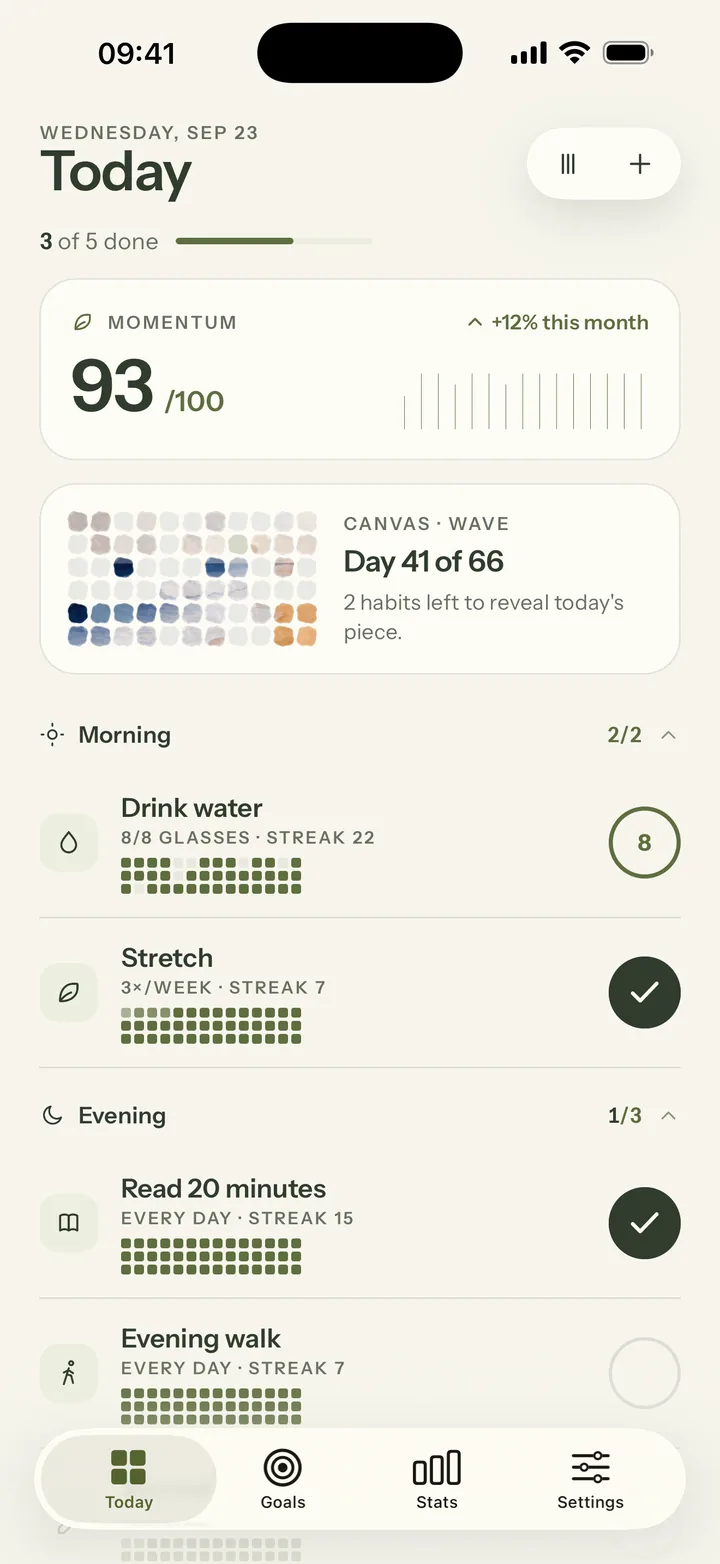
Habit chains are part of the free plan, which holds up to 3 habits: enough for one anchor and a two-step stack. Mosaik Plus adds unlimited habits, Apple Health auto-tracking and a weekly AI coach.
Sources
- Fogg, B. J. (2019). Tiny Habits: The Small Changes That Change Everything. Houghton Mifflin Harcourt.
- Clear, J. (2018). Atomic Habits: An Easy & Proven Way to Build Good Habits & Break Bad Ones. Avery.
- Gollwitzer, P. M. (1999). Implementation intentions: Strong effects of simple plans. American Psychologist, 54(7), 493–503. doi:10.1037/0003-066X.54.7.493
- Gollwitzer, P. M., & Sheeran, P. (2006). Implementation intentions and goal achievement: A meta-analysis of effects and processes. Advances in Experimental Social Psychology, 38, 69–119. doi:10.1016/S0065-2601(06)38002-1
- Lally, P., van Jaarsveld, C. H. M., Potts, H. W. W., & Wardle, J. (2010). How are habits formed: Modelling habit formation in the real world. European Journal of Social Psychology, 40(6), 998–1009. doi:10.1002/ejsp.674
Frequently asked questions
What is habit stacking?
Habit stacking is attaching a new habit to one you already do every day, using the formula “After I [current habit], I will [new habit].” The existing habit acts as the cue, so you don’t have to remember the new one. BJ Fogg calls the existing habit an anchor; James Clear named the technique habit stacking.
Who came up with habit stacking?
The method comes from BJ Fogg, a Stanford behavior scientist, whose Tiny Habits approach anchors a tiny new behavior to an existing routine. James Clear popularized the name “habit stacking” and the formula in Atomic Habits (2018). Both build on research into implementation intentions by Peter Gollwitzer.
Does habit stacking actually work?
The idea behind it is well supported. Plans in the form “when situation X arises, I will do Y” are called implementation intentions, and a 2006 meta-analysis of 94 studies by Gollwitzer and Sheeran found they had a medium-to-large effect on reaching goals. Habit stacking uses an existing habit as the “when”.
How many habits can you stack at once?
Start with one link: one anchor and one new habit. Once that feels automatic, add the next habit to the end of the chain. Long stacks built all at once tend to break, because one missed step can stop everything after it.
What is the difference between an anchor and a habit stack?
The anchor is the habit you already do reliably, like brushing your teeth or pouring coffee. The stack is the anchor plus the new habit you attach to it. In Tiny Habits, Fogg also adds a third step: a small celebration right after the new behavior.
How long does it take for a stacked habit to become automatic?
Expect around two months for a simple daily habit. In a 2010 study by Lally and colleagues, new habits tied to a daily cue took a median of 66 days to feel automatic, with a wide range of 18 to 254 days. Missing a single day did not undo progress.